Spotting it on the shelf from the other side of the store, not even seeing the title yet, I knew I had to have it. A distinctive design and signature style set it apart from the other books in the nonfiction section. As I picked it up, looking at the front and back of the jacket reading the title, it was hard not to gasp aloud. I know for sure I was grinning on the outside but jumping up and down on the inside.
In July of 2009 the graphic design team of Sharon Werner and Sarah Forss, owners of Werner Design Werks, located in St. Paul, Minnesota, published their first book, Alphabesties: And Other Amazing Types (Blue Apple Books) bringing them the 2009 Oppenheim Toy Portfolio Gold Medal Best Book Award and the 2009 Parents' Choice Silver Honor Winner. The equally impressive and entertaining Bugs By The Numbers (Blue Apple Books)(reviewed here) followed in 2011. Alphasaurs and other prehistoric types (Blue Apple Books), their third and newest title, is an alphabetical look at creatures from prehistoric periods that, in a word, is amazing.
Scary and scaly,
lumbering and lumpy,
fast and ferocious,
big, broad and bumpy.
From up north to down south,
from west to east,
The earth was once home to magnificent beasts.
So begins the rhyming introduction that invites readers to step back in time, entering the world recreated by Werner and Forss. For each letter of the alphabet a dinosaur name is written on the page with a phonetic pronunciation beneath. In smaller type on one of the page corners readers will note the time period in which this creature belonged along with whether it ate meat or plants.
Usually along the bottom of a two page spread (ten are single page) alliterative facts focus on outstanding characteristics. At times more notes will appear as if typewritten in a field notebook drawing attention to further specifics. Careful readers will see even more information displayed in the lines used to replicate a particular setting (leaves), the curve of spine or jaw.
What makes this book notable, as were the previous two, is the technique employed to illustrate the animals, insects and now, dinosaurs. Letter by letter, using twenty-six unique typefaces for each dinosaur, their shapes are formed by the letter beginning their name. Lower case, upper case, small medium and large letters are placed, some more bold than others drawing attention to a physical quality, with artistic care and flair.
Each small window of facts along the bottom also incorporates the letter of the moment in the pictorial design. The words beginning with that letter in the statement or phrase will be darker. There are eight fold-outs with die-cuts in each.
The front and back endpapers are a series of small lines in varying thicknesses which initially look like colored stripes but are in fact lines of information. The two pages for the title have the publication information tucked in the lower left hand corner. A large Tyrannosaurus Rex head is coming in from the right taking the "s" in Alphasaurs in its teeth.
For each of the featured dinosaurs they are placed on vivid, varied solid color backgrounds, to set them apart, surround by space and for some the outlines of their natural habitat. None of the letters spelling out the dinosaur names are the same color; their palettes part of the color scheme for a particular page or pages. To enhance interest the dinosaurs are facing in various directions at each turn of page; those on single pages may cross the gutter becoming part of another design.
For the letter "b" Werner and Forss selected brachiosaurus. The prehistoric wonder is spread across two pages with the long neck curving from right back to left, the tail hidden beheld some foliage. When the foliage is unfolded the tail is extended to its full length. On the right side is another fold which lifts up highlighting the neck when fully extended to get leaves on a tree top. Of the four small windows of facts along the bottom one, for example, says This big beast was as tall as a 4-story building. The stories in the building are made of the capital letter 'b" with the spaces colored white to appear like lights
Alphasaurs and other prehistoric types designed, illustrated and written by Sharon Werner and Sarah Forss is another stunning entry in their body of work. Dinosaur lovers will feel like they've struck gold as they read through the pages. My guess is....everyone else will feel the same way too. Now let's see...which one was the size of a muskrat gliding with four wings to move?
Werner's and Forss's main website is linked to the name of their business at the top. For a peek at some of the illustrations in the book follow the link embedded in the title directly above. Please note at the end of the book Werner and Forss list four other important things they learned in the making of this title.
Showing posts with label alphabet. Show all posts
Thursday, December 6, 2012
Monday, November 26, 2012
Move Over Apple, Here Comes Musk Ox
The use of language, the formation of words, in storytelling and how we use them, written or spoken, almost has a magical quality to it. When you think how they can make you feel, where you can go or how attached you become to characters, real or fictional, it's astounding. This is one of the reasons I have been captivated by and motivated to collect alphabet books over the years.
Textual presentations, storylines, coupled with the pictorial interpretations are as unique as the authors and illustrators themselves. My fifty plus collection has recently grown by another title, A Is For Musk Ox ( A Neal Porter Book, Roaring Brook Press) by debut author, Erin Cabatingan with illustrations by Matthew Myers. It would seem that Musk Ox wants to give this volume his own special twist.
Hey!
Hey you,
Musk Ox!
Did you do this?
Did you eat
that apple?
Pieces of apple, a discarded core, lying about his feet, apple juice dripping from his mouth, Musk Ox is confronted by a perturbed Zebra. Finally admitting his guilt, he tells the disgruntled Zebra that on the contrary, the book is not ruined but saved. In fact he has the perfect solution, "a" should be for musk ox.
Of course, Zebra believes this suggestion to be ridiculous. Musk ox does not start with "a". In fact, there is no "a" anywhere in those two words. Ever persistent, ever persuasive Musk Ox has the perfect answer, a musk ox is awesome, lives in the Arctic where some of the state of Alaska is located.
Zebra relents moving on to the letter "b". Musk Ox wants that too, claiming musk oxen fur is brown and black. Completely disgusted at this point, Zebra says he can have "b" and "c" as well. For Musk Ox, that is like waving a red flag at a bull; it's full steam ahead.
When there is not an actual fact to fit a letter, Musk Ox continues to enumerate his many and wonderful attributes, at least in his opinion. Lest you think, it's smooth sailing all the way to "z" for this hooved, horned herbivore, think again. Letters "k", "l" and "m" result in some rather testy back and forth discussions between the two characters.
To be perfectly clear not every letter representation is replaced with musk ox. He does have some alternatives which he justifies using his own personal brand of logic. When Musk Ox finally arrives at "z", he and Zebra finally agree but to the delight of the former and the total humiliation of the latter. Why is Zebra chasing Musk Ox?
Told entirely in conversations between Zebra and Musk Ox, with Musk Ox taking center stage for many of the letters, Erin Cabatingan gives her characters personality with a punch. These two don't mince words (or thoughts) having discussions loaded with attitude. It's a game of one-upmanship in the world of alphabet. Here is a sample passage.
U is for musk ox
Because musk oxen
have underwool!
You said that already.
Well, what do you want
me to say? Underwear?
Some parents might
not like that.
When looking at the front cover, the first thing you notice is the cutout, the bite out of the apple, framing Musk Ox with Zebra standing, hands on hips, looking at that strip of words glued over apple. On the back cover is Zebra's own alliterative views glued over A Is For Musk Ox because...are annoying, and always about as aggravating.... Matthew Myers colorful visuals rendered in oils on illustration board are full of expressive spunk and your-stomach-will-hurt-from-laughing-so-much humor.
A variety of pale backgrounds showcase his characters and their faces as does the changes in perspective and zooming in for close-ups. Depending on the letter and conversation his backgrounds might mirror the narrative; bookcases in a library, snowy Arctic abode of Musk Ox complete with a recliner and television set with rabbit ears. The excluded word is shown somewhere in the overall illustration; clown shivering outside the window of Musk Ox's home, a shattered lamp, a tiny green turtle in the snow. Myers chooses to use a single page, half page or even a double-page spread to focus on a letter adding to the flow, creating a sense of movement.
If you're looking for an upbeat, snappy alphabet book packed with hilarity, A Is For Musk Ox written by Erin Cabatingan with paintings by Matthew Myers is a sure bet. Reading it aloud with a voice brimming with expression, will have listeners laughing like crazy. I can also see this working well as a reader's theater title.
Here is a link to the publisher's website for more illustrations. If you follow the link embedded in Matthew Myers' name you can see other visuals as well as informative pages revealing his illustrative process. Here is a link to the ARKive for Muskox.
When there is not an actual fact to fit a letter, Musk Ox continues to enumerate his many and wonderful attributes, at least in his opinion. Lest you think, it's smooth sailing all the way to "z" for this hooved, horned herbivore, think again. Letters "k", "l" and "m" result in some rather testy back and forth discussions between the two characters.
To be perfectly clear not every letter representation is replaced with musk ox. He does have some alternatives which he justifies using his own personal brand of logic. When Musk Ox finally arrives at "z", he and Zebra finally agree but to the delight of the former and the total humiliation of the latter. Why is Zebra chasing Musk Ox?
Told entirely in conversations between Zebra and Musk Ox, with Musk Ox taking center stage for many of the letters, Erin Cabatingan gives her characters personality with a punch. These two don't mince words (or thoughts) having discussions loaded with attitude. It's a game of one-upmanship in the world of alphabet. Here is a sample passage.
U is for musk ox
Because musk oxen
have underwool!
You said that already.
Well, what do you want
me to say? Underwear?
Some parents might
not like that.
When looking at the front cover, the first thing you notice is the cutout, the bite out of the apple, framing Musk Ox with Zebra standing, hands on hips, looking at that strip of words glued over apple. On the back cover is Zebra's own alliterative views glued over A Is For Musk Ox because...are annoying, and always about as aggravating.... Matthew Myers colorful visuals rendered in oils on illustration board are full of expressive spunk and your-stomach-will-hurt-from-laughing-so-much humor.
A variety of pale backgrounds showcase his characters and their faces as does the changes in perspective and zooming in for close-ups. Depending on the letter and conversation his backgrounds might mirror the narrative; bookcases in a library, snowy Arctic abode of Musk Ox complete with a recliner and television set with rabbit ears. The excluded word is shown somewhere in the overall illustration; clown shivering outside the window of Musk Ox's home, a shattered lamp, a tiny green turtle in the snow. Myers chooses to use a single page, half page or even a double-page spread to focus on a letter adding to the flow, creating a sense of movement.
If you're looking for an upbeat, snappy alphabet book packed with hilarity, A Is For Musk Ox written by Erin Cabatingan with paintings by Matthew Myers is a sure bet. Reading it aloud with a voice brimming with expression, will have listeners laughing like crazy. I can also see this working well as a reader's theater title.
Here is a link to the publisher's website for more illustrations. If you follow the link embedded in Matthew Myers' name you can see other visuals as well as informative pages revealing his illustrative process. Here is a link to the ARKive for Muskox.
Friday, August 10, 2012
August 10 for 10
This will be my first time participating in what is now the third annual August 10 for 10 hosted by Mandy Robek of Enjoy and Embrace Learning and Cathy Mere of Reflect & Refine: Building a Learning Community. This is a time for people who love picture books to come together highlighting those books used in a classroom setting previously, those they intend to use this coming year, those with a common theme or those they would have to have with them in case they are stranded on a desert island. Because my personal collection is extensive and after spending thirty-four years as a school librarian, picking only ten seemed impossible. But as I tell my students start small and build up.
I love alphabet books and have been collecting them for quite some time. My list includes ten (plus one)(shoulder shrug) some of which I have used in the classroom for lessons, some because their approach to the alphabet is innovative or clever and all for their illustrations. I have listed them in order by publication date.
Students have loved this book for years and years. The rhyming and rhythm are contagious. It invites prediction on every turn of page. As a follow up activity students work in pairs thinking of a letter, names for the wife and husband beginning with the same letter, a place to live using the chosen letter, what they might sell and an animal for each beginning with the letter. They can then pick the place where they live or either of the animals to do further research.
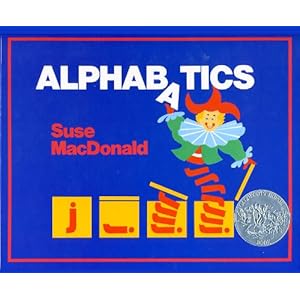
2. Alphabatics (Simon & Schuster Books for Young Readers, 1986) written and illustrated by Suse Macdonld (Caldecott Honor Book, 1987)
Creativity abounds in this book where gradually a letter changes into a word beginning with the same letter. Students love to figure out what the letter becomes as well as think up their own.
3. Animalia (Harry N.Abrams, Inc., 1986) written and illustrated by Graeme Base
I will never forget the first time I saw this book. I spent days looking at the illustrations searching for as many words beginning with each letter of the alphabet not to mention trying to find a small portion of the stripe-shirted boy hidden in each detailed picture (which Base states took more than three years to complete). This is a wonderful volume to use when teaching alliteration, or extending vocabulary. I believe there are still posters available for each of the letters. My favorite is, of course, Lazy Lions Lounging in the Local Library.
4. Tomorrow's Alphabet (Greenwillow Books, 1996) by George Shannon with pictures by Donald Crew
A is for seed---
tomorrow's APPLE
B is for eggs----
tomorrow's BIRDS
U is for stranger---
tomorrow's US
This is another of those books that invites readers to think outside the box; many times asking them to predict a less than tangible answer. After a read through a class alphabet book is generated. Every year I am impressed by the thoughtful pages designed by the students.
5. Quilt Alphabet (Holiday House, 2001) by Lesa Cline-Ransome, illustrated by James E. Ransome
This is a collection of poems for each letter of the alphabet. The poems are riddles which describe something which might be found in a country setting. My favorite is for the letter "N":
As the sun lies down
for an evening nap
And the day begins to fade
The moon and stars come out
to play
And the sky pulls
down the shade
The poems might be difficult for younger children; varying each year with a particular grade level. This volume could be used for a study of country life, historical fiction, a themed unit on quilts, poetry or an alphabet study. I use it with younger students having them create a quilt block (graphically) with a letter in the center. In one corner goes the letter before the center letter and in the opposite corner the letter which follows. In the alternate corners are pictures of items beginning with the center letter.
6. Alphabet Under Construction (Henry Holt and Company, 2002) written and illustrated by Denise Fleming
This is used in conjunction with an author study of Denise Fleming, as a Caldecott Award winning author. The same mouse appears in another of her titles, Lunch which acquaints readers with colors, fruits and vegetables.
7. The Hidden Alphabet (Roaring Brook Press, 2003) written and illustrated by Laura Vaccaro Seeger
This book is an example of sheer beauty. The students love the lift and look idea.
8. Alphabeasties and other Amazing Types (Blue Apple Books, 2009) by Sharon Werner and Sarah Forss
I cannot even begin to imagine the time it took to compile the art for this book. Every time I look through it, I find something I have never seen before. Each animal representing a letter of the alphabet is created with a compilation of those letters. Surrounding the animal are visuals of other words beginning with the same letter. There are flaps to flip and folds to open. Created on heavy paper it is bookmanship at its best. (Is bookmanship a word?) If you do an image search in Google or Bing you can see other images found in the book.
9. L M N O Peas (Beach Lane Books, 2010) written and illustrated by Keith Baker
We are peas---alphabet peas!
We work and play in the ABCs.
I never would have thought to have peas act out occupations but this book is a boatload of fun. Try it with a unit on possible careers or things people do outside of their daily work.
10. Apple Pie ABC (Disney/Hyperion Books, 2011) written and illustrated by Alison Murray
This delectable volume follows a dog and his human during a pie baking adventure. I reviewed this here. I really like the idea of taking the letters of the alphabet to create short phrases when combined are a story.
10A. Z is for Moose written by Kelly Bingham, pictures by Paul O. Zelinsky
I could not make a list without including this book. Certainly it is one of the best alphabet books of 2012. My full review is here.
Okay, I am sorry but I was about to close this post out when I remembered another that must, must be included.
The Z Was Zapped written and illustrated by Chris Van Allsburg. Each year all the grades complete an author study of this phenomenal illustrator.
I will try to follow the rules better next year.
Subscribe to:
Posts (Atom)